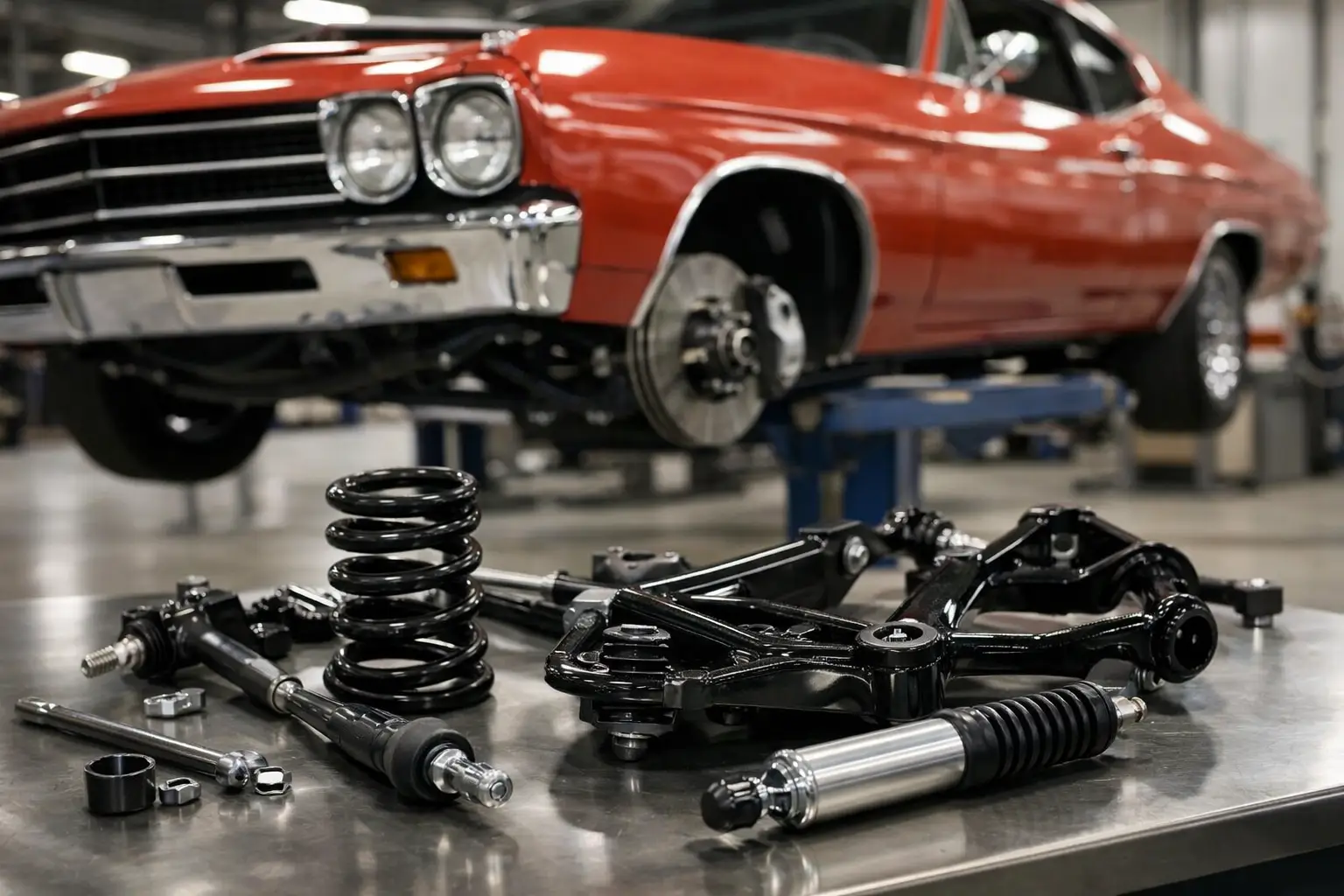
A Chevelle that wanders, squeaks over every driveway, or sits nose-high on one corner is telling you the same thing – the suspension has aged out. On a 1964-72 GM A-body, that usually means more than one worn part. A solid chevelle suspension restoration guide starts with the full system, because replacing one bushing or one shock rarely fixes the way an old chassis feels on the road.
What a chevelle suspension restoration guide should cover
Suspension restoration is not just about ride comfort. On a Chevelle, Malibu, or El Camino, the front and rear suspension affect steering response, tire wear, braking stability, and how confident the car feels at highway speed. If the car dives hard under braking, clunks over bumps, or needs constant correction in the lane, you are dealing with wear that has built up over decades.
The biggest mistake restorers make is treating the suspension like a series of isolated parts. A new set of shocks on tired springs and loose ball joints will still drive like a tired car. The better approach is to inspect the entire system, decide whether your goal is factory-correct restoration or mild street improvement, and replace components in matched groups.
Start with a full front-end inspection
On most Chevelles, the front suspension tells the story first. The upper and lower control arm bushings, ball joints, coil springs, sway bar bushings, tie rod ends, center link, idler arm, and shocks all work together. If several are worn, the car may feel loose even if one or two pieces look acceptable.
Begin with ride height. A sagging front end often points to fatigued springs, but do not assume springs are the only issue. Old rubber bushings can distort control arm position, and collision damage or previous poor repairs can change stance as well. Uneven height side to side deserves a closer look before parts are ordered.
Next, check for play at the wheels and steering linkage. Excess movement in ball joints or tie rod ends will show up fast when the front end is off the ground. Dry-rotted control arm bushings, split sway bar bushings, and leaking shocks are all common on original or older replacement parts. If the car still has unknown-age components, a complete front-end rebuild is often more efficient than chasing one problem at a time.
Control arms, bushings, and ball joints
This is where restoration quality matters. Factory-style rubber bushings generally make the most sense for stock restorations because they preserve the original ride character and avoid the harshness that can come with some firmer materials. For a street-driven car that you want to feel close to original, rubber is usually the right answer.
If your priority is tighter handling, there are trade-offs. Firmer bushings can reduce deflection, but they can also increase noise and make the car feel less like a factory A-body. That may be acceptable on a pro-touring build, but not on a numbers-conscious restoration. Ball joints should be treated as wear items, not maybe-later items. If the front suspension is apart, replacing them is cheap insurance.
Springs and shocks
Coil springs determine stance as much as ride quality. Over time, original springs lose height and rate, which can make the car sit unevenly and bottom out more easily. Choosing the right replacement spring matters. A stock small-block Chevelle, a big-block SS, and an El Camino do not all want the same spring rate.
Shocks are equally important, but they are not a bandage for worn hard parts. Good shocks control movement. They do not correct bad geometry, collapsed bushings, or weak springs. For a factory-style restoration, stick with stock-type valving and dimensions. If the goal is sharper road manners, choose carefully. Too much shock for a mostly stock suspension can make the ride busier than most owners expect.
Do not ignore the rear suspension
A proper chevelle suspension restoration guide has to spend time on the rear, because the rear suspension on these cars does plenty of work. Worn rear control arm bushings, weak springs, tired shocks, and deteriorated body mounts can all contribute to poor traction, rear steer feel, and that unsettled motion over uneven pavement.
Inspect upper and lower rear control arms for bushing wear and damage. If the rear of the car shifts slightly under throttle or feels unstable in sweeping turns, the bushings may be allowing too much movement. Rear coil springs should be checked for sag and uneven height the same way as the front. El Camino owners especially need to consider how the vehicle is used. A car that sees cargo weight may need different rear spring choices than a cruiser that stays empty.
Body bushings also deserve attention here. On an A-body, worn body mounts can create rattles, panel alignment issues, and a loose overall feel that gets blamed on the suspension. If you are restoring a car that still rides on old mounts, replacing them can noticeably tighten up the chassis.
Match the parts to the build
This is where many restorations go off track. It is easy to buy parts that sound better on paper than they feel on the road. The right suspension package depends on what the car is and how you drive it.
For a stock restoration, factory-style control arm bushings, correct-rate springs, stock-type shocks, and proper steering components are usually the best route. You preserve the character of the car and avoid fitment surprises. For a street machine, you may want firmer springs, upgraded sway bars, or performance shocks, but those changes should be made as a system. Mixing stock springs with aggressive shock valving or adding one oversized bar without addressing the rest of the chassis can produce results that feel uneven.
Authenticity matters too. Owners restoring SS models or cars headed for judged events often want parts that look, fit, and function as close to original as possible. That is a different goal than building a weekend canyon carver, and the parts strategy should reflect it.
Replace hardware when it makes sense
Suspension hardware lives a hard life. Rusted bolts, fatigued fasteners, worn washers, and damaged nuts can slow down a restoration and affect final results. Reusing original hardware is sometimes appropriate for a highly detailed build if it is inspected and restored properly, but many drivers are better served by replacing critical hardware during the rebuild.
This is especially true when bushings, control arms, and steering components are being replaced together. Fresh hardware helps everything torque correctly and saves frustration during installation. It also reduces the chance of fighting seized components the next time the suspension is serviced.
Alignment is part of the restoration, not the last errand
Once the suspension is rebuilt, alignment is not optional. It is a critical part of getting the car to drive the way it should. New springs need to settle, ride height needs to be verified, and the front end needs to be aligned to sensible specs for your tire and wheel setup.
A stock-spec alignment is often a good baseline for factory restorations, but modern tires sometimes respond well to slight adjustments within reason. The key is to work with someone who understands classic GM A-bodies. A bad alignment can make new parts feel disappointing very quickly.
Common mistakes that cost time and money
The first is replacing only the obvious failure. One loose ball joint may be easy to spot, but if the bushings and tie rods are just as old, the result will still be mediocre. The second is buying parts without confirming year, model, engine weight, and intended ride height. A 1964 car is not identical to a 1972 car, and Chevelle, Malibu, and El Camino applications can differ in important ways.
Another common issue is over-restoring for the wrong purpose. Not every street Chevelle needs the firmest suspension available. Plenty of owners are happiest when the car tracks straight, rides correctly, and feels like a well-sorted classic instead of a modernized compromise.
If you are sourcing multiple components, this is where a specialized supplier helps. Classic Parts has built its reputation around 1964-72 GM A-body vehicles, and that kind of product depth matters when you are trying to get the right springs, steering parts, bushings, and hardware the first time.
Build a suspension that fits the car
The best restoration is not the one with the longest parts list. It is the one that makes the car feel right again. When the ride height is correct, the steering is predictable, the chassis is quiet, and the car tracks with confidence, you know the job was done with the whole system in mind.
That is the standard worth chasing on any 1964-72 Chevelle. Get the foundation right, and every mile after that feels more like the car Chevrolet intended you to enjoy.