Nothing spoils confidence in a freshly restored Chevelle faster than a fuel gauge you cannot trust. A proper chevelle fuel tank sending unit review starts there – not with catalog photos, but with what happens when the gauge reads half full, the tank is nearly empty, and you are left guessing whether the problem is the sender, the float, the ground, or the gauge itself.
For 1964-72 Chevelle, Malibu, and El Camino owners, the sending unit is one of those small parts that carries more responsibility than it gets credit for. It has to match the tank, the gauge, the fuel line setup, and the year range. It also has to survive in modern fuel, hold a stable resistance signal, and seal correctly at the tank. If any one of those details is off, the result is a car that looks right and drives well but still leaves you second-guessing the dashboard.
What matters in a Chevelle fuel tank sending unit review
The first thing to understand is that not all sending units fail in the same way, and not all replacements are built to the same standard. Some units install cleanly but read inaccurately across the middle of the gauge range. Others work well electrically but use thinner metal lines or lower-quality hardware than many restorers expect. A few look correct at first glance but are not the best match for a factory-style restoration.
That is why a useful review has to go beyond whether the part simply fits in the tank opening. For a classic GM A-body, the real test is how well the unit matches original operating behavior. That includes the resistance sweep, the movement of the float arm, the quality of the pickup tube, and the reliability of the ground connection.
On these cars, even a good sending unit can be blamed for problems caused elsewhere. A weak ground strap, a tired dash gauge, damaged wiring, or an incorrect tank vent setup can make a quality sender look defective. So when evaluating one, it helps to judge both the part itself and the system it is being installed into.
Fitment is where most problems start
A sending unit has to match more than the vehicle name on the box. Year range matters, engine combination can matter, return line versus non-return line matters, and tank style matters. If your Chevelle has been modified over the years, this matters even more.
Many restorers run into trouble when a car no longer has its original tank or fuel line arrangement. A unit intended for one setup may physically install in another tank, but the line routing, float travel, or gauge reading can be off. That is especially common on project cars that have had engine swaps, replacement tanks, or partial restorations done over several decades.
The best replacement units tend to be the ones clearly built for the exact application rather than broad “fits many models” versions. A correct application-specific sender usually gives you better tube routing, better float geometry, and a cleaner install. For owners trying to keep things factory-correct, that is worth paying attention to.
Tank depth and float travel
One of the easiest issues to miss is tank depth. If the float arm geometry does not match the tank, the gauge may read full for too long, drop too quickly, or never reach empty accurately. That makes the car frustrating to drive, especially on longer trips where you are trying to use the gauge like you would in a modern vehicle.
A good sender should allow the float to sweep its full range without binding or contacting the tank baffle. If that motion is wrong, no amount of wishful thinking at the dash will fix it.
Line size and factory configuration
Fuel line diameter and return line provisions also deserve attention. Some owners just want a driver-quality replacement. Others want a unit that matches original specs for a small-block or big-block application. Those are different goals, and the right part depends on which camp you are in.
If originality matters, details like tube bends, finish, and line layout should be part of the buying decision. If drivability is the priority, then build consistency and leak-free installation may matter more than exact visual duplication.
Build quality separates a dependable sender from a short-term fix
In any chevelle fuel tank sending unit review, build quality deserves a close look because this is not a part you want to replace twice. Once the tank is installed, access is limited, and repeating the job costs time, fuel, and patience.
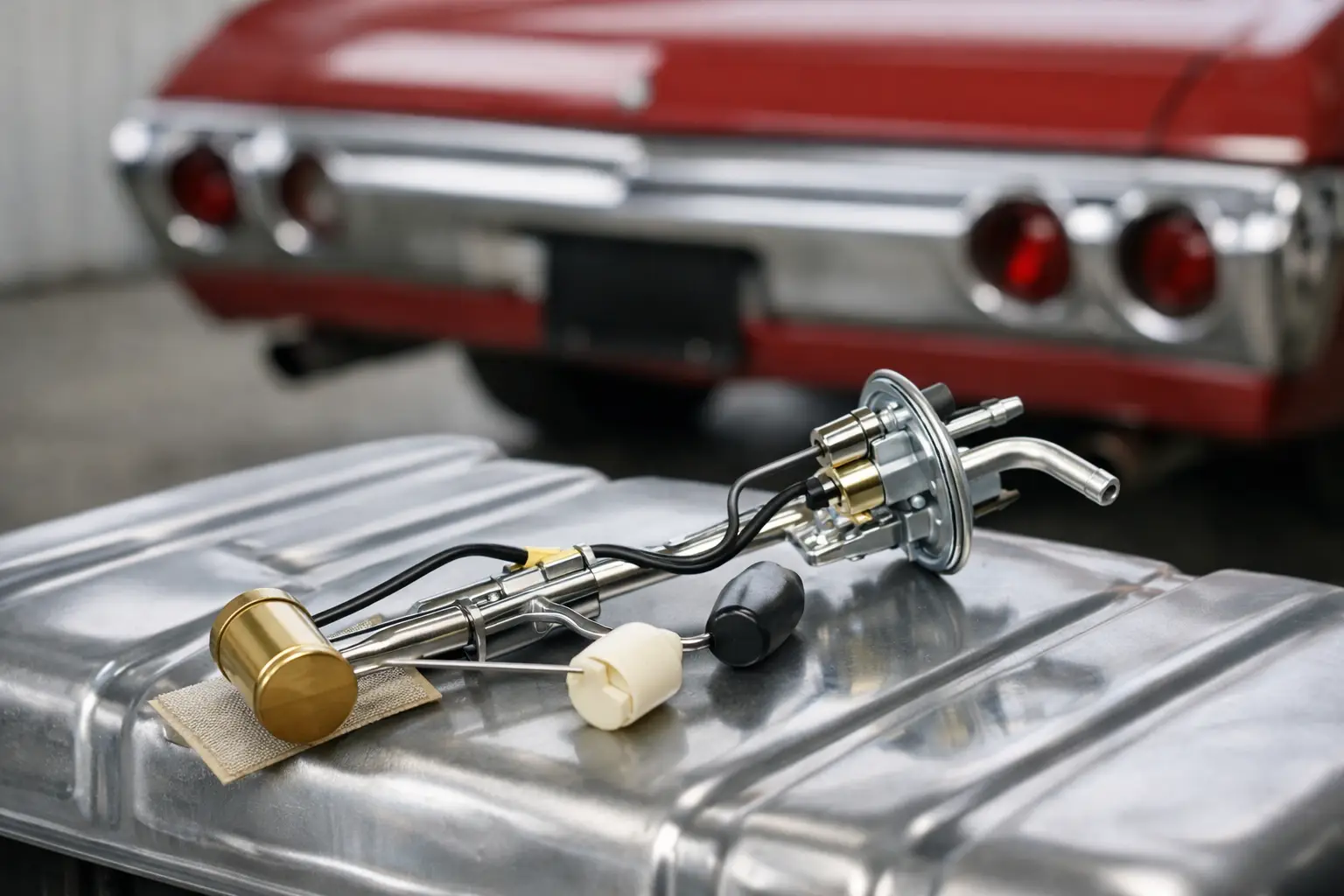
The better units generally show their quality in a few places. The pickup tube should feel solid, not flimsy. The soldered or joined areas should look clean. The rheostat assembly should move smoothly without rough spots. The float should be made from material that stands up well to modern fuel blends, and the lock ring and seal should fit securely.
This is also where reproduction quality can vary. Some reproductions are excellent and perform just as they should. Others are acceptable for a budget-minded repair but may not satisfy a restorer who expects factory-style accuracy and long-term confidence. That is the trade-off – lower initial cost can be attractive, but labor and aggravation can quickly erase the savings if the sender proves inconsistent.
Gauge accuracy is the whole point
A fuel sending unit can look perfect and still fail the most important test: giving the driver an honest reading. On a classic Chevelle, that means the gauge should respond steadily and predictably from full to empty, without wild swings or a dead spot in the middle.
The resistance range has to be correct for the factory gauge system. If it is not, the gauge may sit above full, never reach full, or linger at one level before dropping suddenly. For some owners, that is just an annoyance. For others, especially those who actually drive their cars instead of trailering them, it is a real reliability concern.
It is also worth saying that old gauges are not always precise even when everything is working properly. These cars were never designed to provide modern digital accuracy. A quality sender should still give a trustworthy range, but expecting laboratory precision from a 1960s or early 1970s fuel gauge system is unrealistic. The goal is confidence, not perfection.
Installation details that affect results
A sending unit review is incomplete without talking about installation, because many so-called bad units are actually victims of poor sealing, weak grounds, or rushed assembly.
The tank opening must be clean, the seal must be seated correctly, and the lock ring needs to engage fully. If the ground path is questionable, the gauge reading can become erratic even when the sender is fine. On these cars, a clean metal-to-metal ground connection is not optional.
Bench-testing before installation is a smart move. Manually moving the float through its range while checking the gauge response or resistance reading can save you from reinstalling the tank later. Experienced restorers know this step is worth the extra few minutes.
Original-style restoration or driver-grade replacement?
This is where the right choice depends on your build. If you are restoring a numbers-conscious car, appearance and factory-style details matter almost as much as function. You want a sending unit that looks right, routes correctly, and matches the original system as closely as possible.
If you are building a dependable weekend driver, the priority may be simpler. You want accurate readings, solid construction, and a clean fit with your current tank and fuel line setup. In that case, a high-quality reproduction can be the right answer even if it is not perfect for concours judging.
Neither approach is wrong. The mistake is buying a sender meant for one goal and expecting it to satisfy the other.
The final verdict on choosing the right unit
Most Chevelle fuel tank sending unit complaints come down to three things: incorrect application, inconsistent reproduction quality, or installation shortcuts. When the application is right and the unit is well made, performance is usually straightforward. The gauge reads as it should, the seal holds, and the car becomes a lot more enjoyable to drive.
For 1964-72 owners, the best sending unit is not automatically the cheapest or the one with the broadest fitment claim. It is the one that matches your exact tank and fuel system, uses dependable materials, and gives you confidence every time you glance at the dash. That is why buying from a specialist with deep A-body experience, like Classic Parts, often makes the process easier – you are not just buying a part number, you are buying a better chance of getting the right part the first time.
If your fuel gauge has been lying to you, treat the sender as a system-critical part, not a minor accessory. Get the fitment right, check the details before installation, and your Chevelle will reward you with one less mystery every time you turn the key.