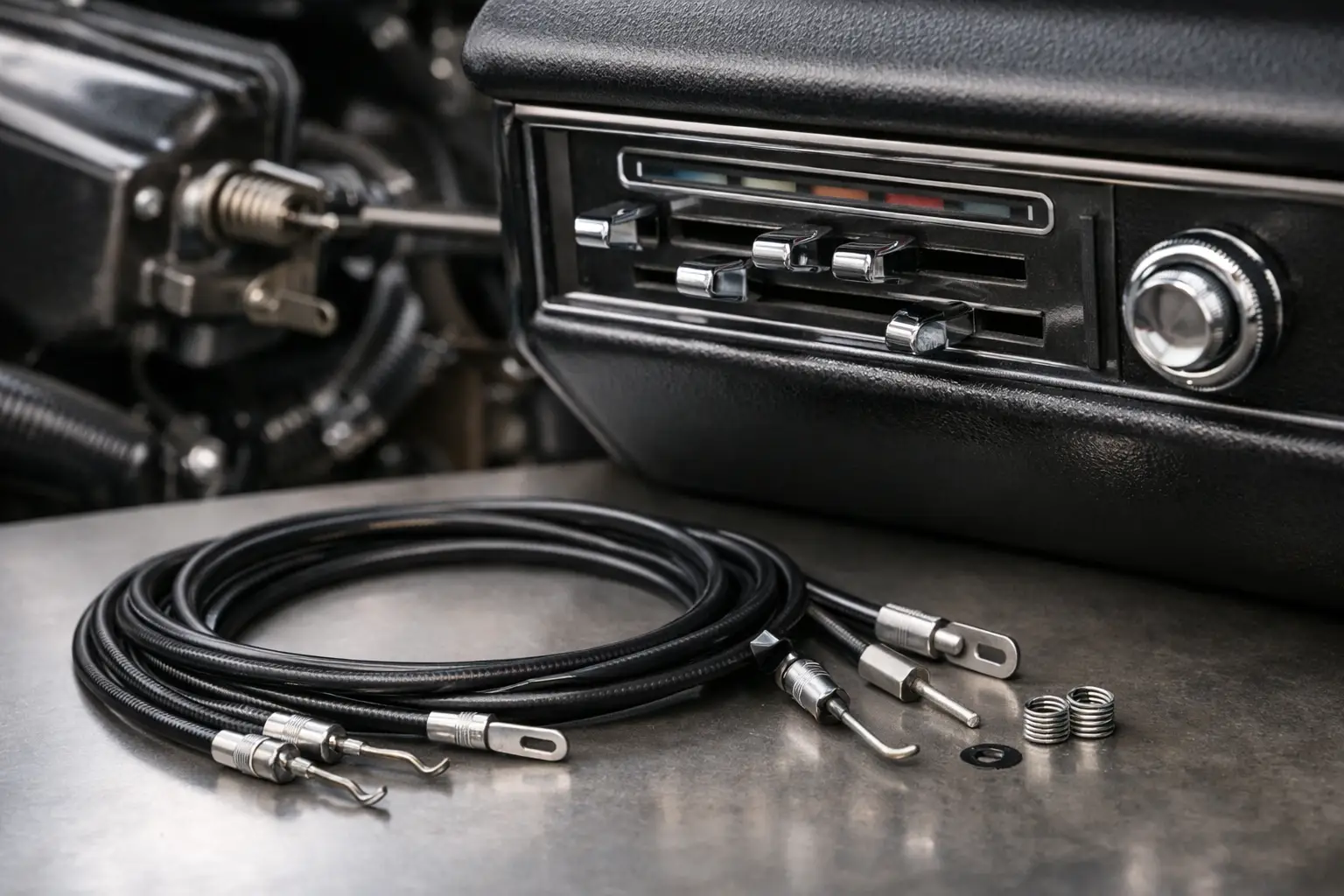
When the dash lever in your Chevelle feels stiff, loose, or does nothing at all, the problem often comes back to the chevelle heater control cables. These simple mechanical cables are easy to overlook, but they play a direct role in whether your heater box doors move correctly and whether the car delivers heat, defrost, or fresh air the way GM intended.
On a 1964-72 Chevelle, Malibu, or El Camino, the heater and ventilation system depends on precise cable movement. If a cable is kinked, stretched, misrouted, or attached to the wrong lever, the control panel may still slide, but the system will not respond correctly. That can mean weak defrost on a cold morning, poor heat control, or doors that never fully open or close.
What chevelle heater control cables actually do
These cables connect the dash control assembly to the heater box doors and related control points. When you move a lever on the control head, the inner wire travels inside the cable housing and transfers that motion to a flap or lever at the heater box. It is a straightforward setup, but it has to be adjusted correctly to work well.
Most owners notice cable issues when one of three things happens. The lever becomes hard to move, the lever moves too freely with no resistance, or the air does not change modes even though the control appears to move normally. In all three cases, the cable is either binding, disconnected, worn out, or out of adjustment.
Because these systems are mechanical, they give good feedback when everything is right. A properly installed cable should move smoothly, with light but noticeable resistance. It should not feel gritty, forced, or sloppy.
Why these cables fail over time
Age is the biggest reason. Original cables have often been in service for decades, and even well-kept cars can develop internal drag as the liner dries out, the cable corrodes, or the housing starts to deform. Cars that sat for long periods are especially prone to sticky controls because the cable and heater box pivots have not been exercised.
Previous repair work is another common factor. Many heater control problems start after a dash restoration, heater box service, or control panel replacement. If the cable was routed with too tight a bend, clamped in the wrong position, or connected to the incorrect arm, the control travel will be off. The system may work partway but never reach full heat or full defrost.
There is also the issue of mixed parts. Across 1964-72 A-body models, fitment matters. Cable length, end style, mounting points, and control head design can vary by year and by heater or air conditioning application. A cable that is close is not always correct, and close usually leads to poor travel or awkward routing.
Stiff controls are not always just a bad cable
This is where restoration experience matters. A stuck lever can point to a worn cable, but it can also mean the heater box door shaft is binding, the control head itself is damaged, or a flap inside the box has swollen seals or debris causing interference. Replacing the cable alone may improve things, but if the door mechanism is the real source of drag, the problem can come right back.
That is why a good inspection should include both ends of the system. Move the cable by hand with it disconnected. If it feels smooth on its own, the trouble is likely in the heater box or control assembly. If it drags while free, the cable is usually the issue.
Choosing the right replacement cable
If your goal is factory-style operation, fitment is everything. The correct cable should match your model year, body style application, and whether the car is equipped with heat only or air conditioning. Even a small mismatch in housing length or wire travel can leave the door short of full range.
This is one of those parts categories where specialized inventory makes a real difference. A general parts source may list a broad cable fitment range, but restorers know that GM A-body details matter. Correct mounting tabs, proper bends, and accurate end fittings save time during installation and help avoid the frustration of trying to force an almost-right part to work.
For many owners, the decision comes down to originality versus function. A quality reproduction cable is often the practical answer when the original is seized, frayed, or damaged. If you are building a highly original car, you may also consider NOS or good used components when available. It depends on the condition of the rest of the system and how correct you want the restoration to be.
Installation details that make or break the job
Chevelle heater control cables are not especially complicated to install, but they can be fussy. The most common mistake is failing to set both the dash lever and the heater box lever in the proper position before securing the cable. If one side is at full travel and the other is not, the system will be out of sync from the start.
Routing matters just as much. The cable needs smooth bends, not sharp turns. If it gets pinched behind the dash or pulled too tightly across brackets, the lever effort will increase and the cable life will drop. You want the housing secured firmly enough to prevent movement, but not distorted by over-tightening clamps or retainers.
It also pays to inspect the control head while everything is apart. If the lever mechanism is worn or loose, a new cable will only fix part of the problem. The same goes for the heater box arms and pivots. A fresh cable connected to rusty, sticky linkages is not a complete repair.
Adjustment is where many systems go wrong
After installation, check full movement in every position. The lever should reach its stops without forcing the cable, and the door at the other end should also complete its full range. If the lever feels tight at the end of travel, do not muscle it. Recheck the clamp point and lever alignment.
This is also a good time to verify the function, not just the movement. Make sure defrost air actually shifts to the windshield outlets, vent mode changes as expected, and heat blend response matches the lever position. Mechanical travel alone does not guarantee proper door operation.
When to replace more than the cable
In many restorations, the cable is only one part of the fix. If the dash is apart or the heater box is already out, it makes sense to inspect related components at the same time. Worn seals, cracked ducts, tired control heads, rusty linkages, and brittle hardware can all affect performance.
There is a practical balance here. If your car is a driver and the cable is the only failed piece, replacing just that part may be enough. But if you have inconsistent airflow, weak defrost, and controls that have been troublesome for years, a more complete refresh often saves labor in the long run. Going back under the dash twice is rarely anyone’s favorite job.
For owners working through a proper restoration, this is the stage where factory-correct parts really earn their value. Good fitment reduces rework, shortens installation time, and helps the finished car operate the way it should. That matters whether you are building a judged car or simply want the cabin controls to feel right every time you slide the lever.
What experienced Chevelle owners look for
Enthusiasts who have worked on these cars for years tend to judge heater controls by feel as much as function. The levers should not be floppy. They should not require two hands. The system should respond predictably, and the cable should not scrape or hang during travel.
That is why buying from a true A-body specialist matters. With a category like chevelle heater control cables, the value is not just having a part on the shelf. It is having the right version for the application, plus the experience to help a customer sort out whether the issue is the cable, the control head, the heater box, or all three. That kind of support can save hours in the garage and keep a restoration moving.
Classic Parts has built its reputation around exactly that kind of confidence – hard-to-find inventory, factory-minded fitment, and practical help for Chevelle, Malibu, and El Camino owners who want the job done right.
If your heater controls have been stiff, inconsistent, or dead for years, this is one of those repairs worth addressing sooner rather than later. A properly operating cable system does more than improve comfort. It brings back the original feel of the car, and that is the kind of detail every solid restoration deserves.